
The Cuilcagh Boardwalk, aka the Stairway to Heaven: A Field Guide for the Unwary
Somewhere around step 400 of the Cuilcagh boardwalk, most people stop thinking about the view and start doing quiet arithmetic about their knees. The view is fine. The knees are the part nobody puts on the poster.
The mountain is called Cuilcagh, from the Irish Binn Chuilceach, which polite translations render as “chalky peak”. It stands 666 metres high, a number the marketing people have handled with surprising restraint. It sits on the border between County Cavan and County Fermanagh, which makes it the highest point of both counties at the same time — the only cross-border county top in Ireland, and the single best example on the island of a mountain that refuses to pick a side.
That border detail matters, because it explains the first thing that confuses everyone: the boardwalk is in Northern Ireland, the car park is in a field that can only be described as philosophically Cavan, and you will spend the drive to it passing through enough small towns to forget which country you started in. From Cavan town it’s roughly an hour of winding roads, give or take the cows.
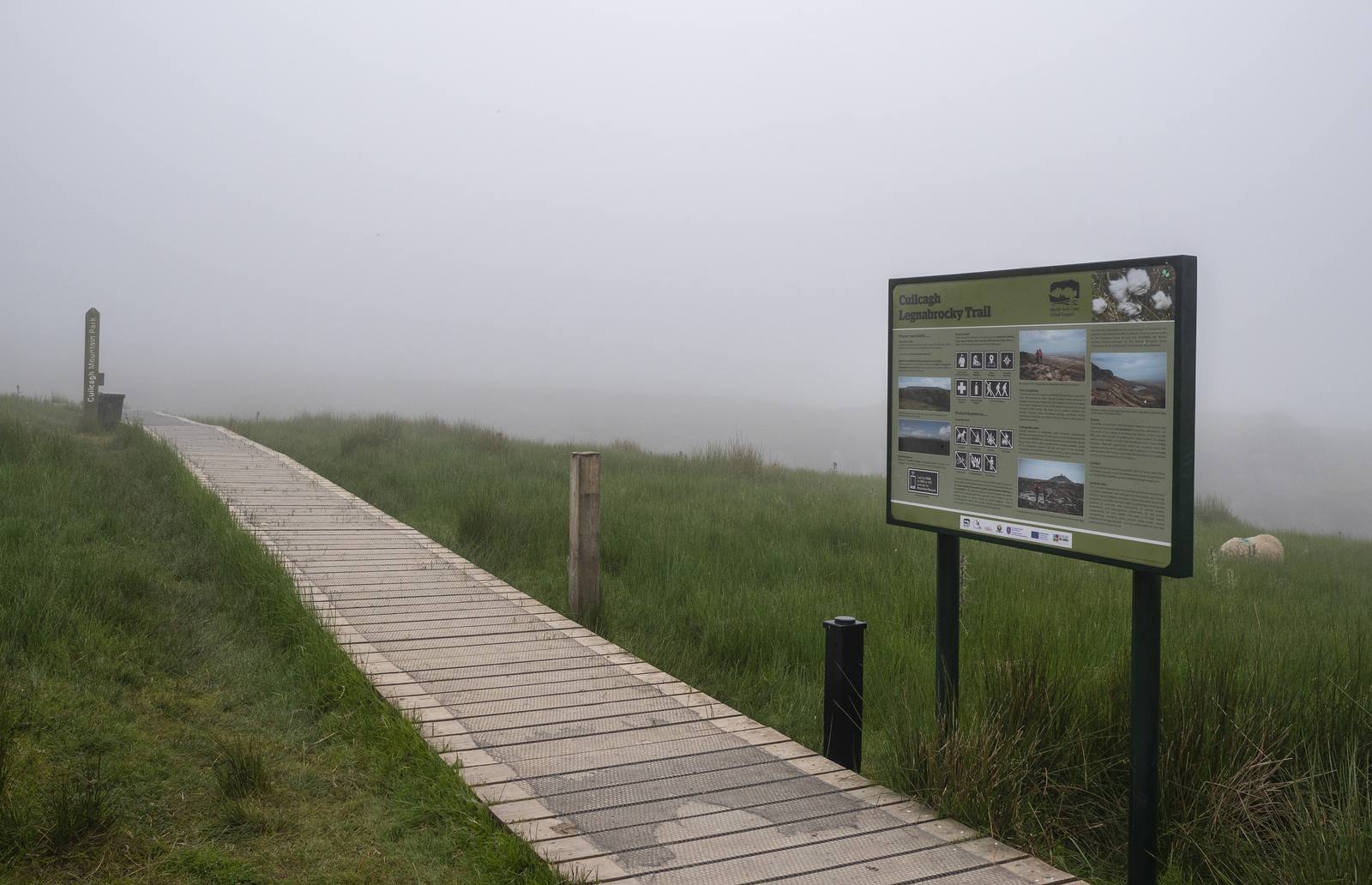
First, the layout, because the brochures lie by omission
The famous bit — the steep wooden staircase that earned the trail its nickname — is only about a quarter of the walk. Before you get anywhere near heaven you’ll cover five kilometres of wide, undulating gravel track across open moorland, past abandoned stone cottages and dry-stone walls and sheep that have seen it all before. It’s properly lovely. It is not, however, the Stairway to Heaven. The Stairway to Heaven is the final kilometre, and it earns the capital letters.
That last stretch climbs about 450 wooden steps, single file, to a viewing gallery close to the top of the mountain. The whole excursion is a 12 to 14 kilometre round trip, and the official advice is to allow two and a half to three and a half hours. The unofficial advice, based on the people you will meet coming back down, is to double the estimate and halve your ambitions. Nobody has ever finished this walk and said “that was quicker than I expected”.
Why the boardwalk exists at all
The boardwalk was built in 2015, not because walkers needed a handrail, but because the blanket bog underneath was being trampled into soup by everyone cutting across it. It worked almost too well: visitor numbers went from around 3,000 a year to somewhere north of 60,000. That is the environmental equivalent of putting a plaster on a graze and coming back to find a queue outside the surgery.
The trail starts from the Legnabrocky car park, which is privately owned and pay-and-display, so arrive with coins, a card, and no strong opinions about pricing. There are no toilets and no shops on the trail itself. The phrase “pack it in, pack it out” applies to your sandwich wrappers and, frankly, to your dignity.
What the Instagram captions leave out
You will queue. On a fine summer weekend the steps are a conga line of waterproof jackets and phone selfie sticks, and the summit gallery becomes a politely competitive photography studio. The light mist the locals call “a soft day” is, to everyone else, “why didn’t I bring my waterproof”. Bring the waterproof.
Cuilcagh makes its own weather and does not consult you first. The mountain is a Ramsar site — internationally important wetlands, if you want the proper term — and fog on the boardwalk is quietly beautiful. It is also completely disorienting. If the forecast says low cloud, treat the trail the way you’d treat a walk-in freezer: go in, do the business, come straight back out.
The steps themselves were built to protect the peat, but they also function as a social experiment in how polite strangers can remain while queuing up a staircase in the wind. The answer is: surprisingly polite, mostly. Unless it’s bucketing, in which case all bets are off and the person in front of you will stop to photograph a bog cotton plant you have already seen four times.
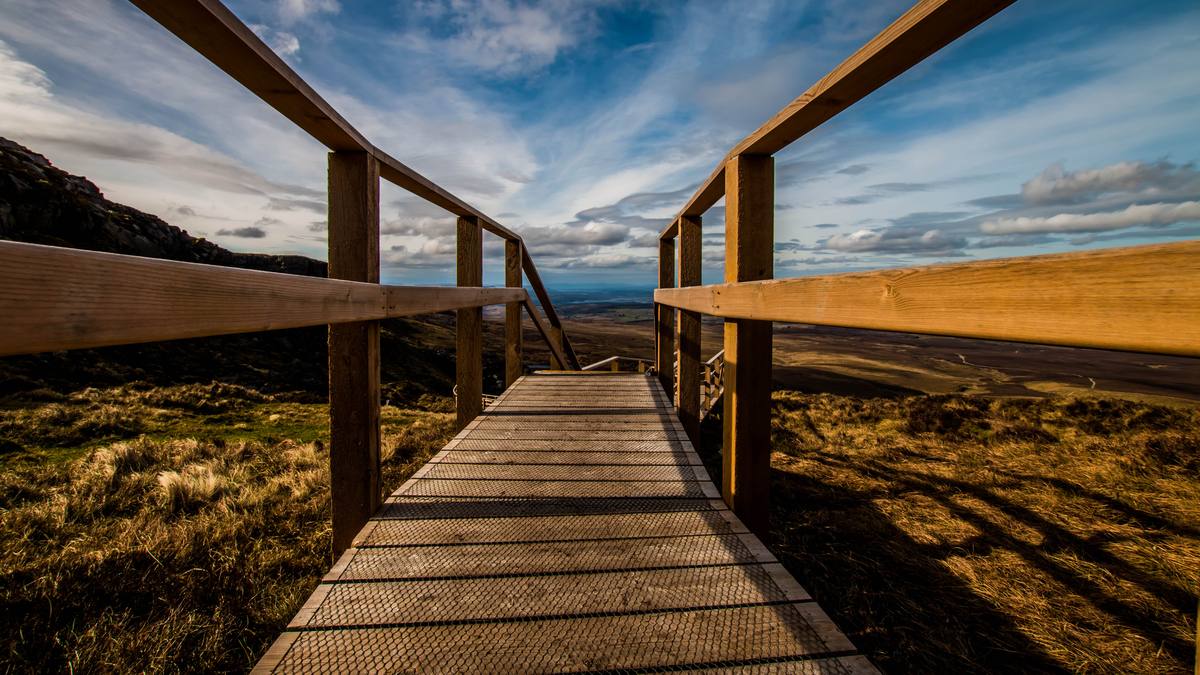
Water that takes the long way round
One of the quieter marvels of the mountain is what happens to the rain on its southern slopes. It doesn’t stay around. It disappears underground and resurfaces several miles away at the Shannon Pot, in the Cuilcagh foothills in County Cavan, which is the traditional source of the River Shannon. So the river that flows through the middle of Ireland, past Athlone and Limerick and out to sea, starts as a puddle on a hill in Cavan that politely declined the direct route.
The Pot itself is worth a visit — a pool about 16 metres across, unremarkable to look at, remarkable to think about. You can stand beside it and consider the entire river system of Ireland arriving at that one hole in the ground. It’s the kind of fact you’ll appreciate more after you’ve done the walk, when your legs are gone and you need a reason to feel profound.
The practical bit, delivered without a spreadsheet
Boots, or very serious trainers — the gravel track is fine, the steps are fine, the bog at the edges is not. Waterproofs even on a blue day, for reasons already established. Layers, because the temperature at the top will disagree with the temperature at the car park. Water and food, because there is nowhere to buy either once you start. A power bank for the phone, because you will photograph the steps, the fog, the sheep and the view, and your battery will give up somewhere on the long way back.
Start early. The car park fills and the trail develops a queue like a bank on pension day. Check the weather before you leave the house, then check it again when you arrive, because the two forecasts will not agree and the mountain will have its own opinion regardless.
Dogs are a matter of ongoing debate and occasional enforcement — check the current rules before you go, and don’t be the person who discovers them the hard way. Leave no trace, close the gates behind you, and if you pass a slower walker on the steps, resist the urge to overtake. There is nowhere to go anyway.
And afterwards
You will be hungry. This is not speculation; it is the thermodynamic consequence of fourteen kilometres and four hundred and fifty steps. The good news is that Cavan town is a short drive away and the post-hike meal is a sacred Irish ritual, second only to the hike itself being discussed at length while you eat.
Our vote is pizza, and we say that with the bias of people who make the dough. It’s proofed for 72 hours before it goes anywhere near the oven, which is longer than some relationships survive a weekend walk. Check the takeaway menu at https://luso.ie/takeaway-cavan-town/ before you leave the car park, and reward yourself accordingly. You’ve walked to heaven; you’re entitled to a slice of it.
If you’d rather plan the whole visit around the food first, there’s more about the restaurant over on the Luso website, but the short version is: it exists, it’s warm, and it’s open when you’ll need it.
One last thing. The boardwalk is one of those rare attractions that is better than its reputation, and its reputation is enormous. The steps are steep, the weather is personal, and the view from the top — fog or no fog — is the kind that makes you stand there longer than the queue behind you approves of. Go early, go prepared, and go hungry. The mountain will do the rest.
Further reading
https://www.walkni.com/walks/cuilcagh-boardwalk-trail/