The Best Pizza in Cavan Town (by a mile)
Seventy two hours before it reaches you
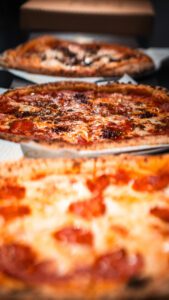
The dough is mixed, then left alone for three days. That slow prove is what gives the base its open crumb and the slight sourness underneath the tomato. You cannot rush it and you cannot fake it with yeast on the morning.
Flour, water and fire
We are one of only a small handful of Pizzerias in Ireland that mill their own flour. We fresh mill wheat using a traditional stone mill which conserves more healthy oils and minerals for better flavour, texture and much better nutrition. We mix our house-milled flour with regeneratively farmed UK & Irish flours and Italian Pizza Flour. We have a traditional stone oven, brought in from Naples and built on site which runs hot enough to finish a pizza in the time it takes to pour a drink.
What goes on top
Corleggy parmesan from Belturbet. Meat from Herd Butchery in Butlersbridge. Mozzarella from Sabanero in Galway. Pepperoni from The Wooded Pig Organic Farm in Kells. The shorter the distance an ingredient travels, the better it tends to taste, and in this part of Cavan the distances are short.
Where to find us
Newcourt car park off Church Street, in the centre of Cavan town, behind the Black Horse Inn.
Questions people ask
Is there a good restaurant near me in Cavan town?
If you are in Cavan town centre you are within a few minutes walk of Luso. We are on Church Street in Abbeyland, behind the Black Horse Inn,
Where can I get sourdough pizza near me in Cavan?
Luso on Church Street bakes Neapolitan sourdough in a stone oven, using dough proved for 72 hours. It is the only sourdough pizza being made in Cavan town.
So, what is sourdough Neapolitan pizza?
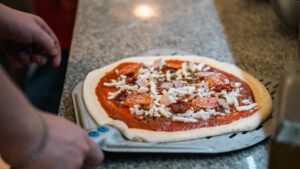
Two separate things are being described by that phrase, and it helps to take them apart.
Neapolitan refers to a style with a legal definition behind it. The Associazione Verace Pizza Napoletana, founded in Naples in 1984, sets out what qualifies: a base no more than about 3mm thick in the centre, a raised rim, baked at roughly 430 to 480°C for 60 to 90 seconds. Type 00 flour, water, salt, and a leavening agent. Nothing else in the dough.
Sourdough refers to how the dough is raised. Instead of commercial baker’s yeast, you use a starter, a living culture of wild yeast and lactic acid bacteria kept alive by regular feeding. The Naples tradition has its own word for it, criscito, and it long predates the packet yeast that replaced it in most kitchens.
So sourdough Neapolitan pizza is the Naples format raised the old way.
Why the leavening changes the result
Commercial yeast has one job and does it fast. A dough can go from mixed to ready in a couple of hours, which is why almost every pizzeria uses it. The economics are unarguable.
A starter is slower, because it contains bacteria as well as yeast. The yeast produces the carbon dioxide that lifts the dough. The lactic acid bacteria produce lactic and acetic acid, which is where the flavour comes from, and they need considerably more time to do it.
That extra time is why sourdough versions are usually fermented for 24 to 72 hours rather than two. The acids build gradually and give the base a faint sourness that sits under the tomato rather than on top of it. Long fermentation also relaxes the gluten network, which produces the irregular open crumb inside the rim, with holes of wildly different sizes rather than an even fine texture. Which is also why you never feel bloated after a Luso Pizza – slow proofed pizza is much more digestible compared to commercially produced, short proof options.
Toppings and cheese
The AVPN rules are as specific about the top as they are about the base, and the guiding principle is restraint. A 90-second bake cannot cook a heavily loaded pizza. Anything piled on will steam the base rather than crisp it.
Our tomatoes are San Marzano – grown on the foothills of Vesuvius near Naples.
Our Mozzarella comes from Sabanero in Galway using the best of Irish dairy. We use a mix of mozzarella di bufala campana (made from water buffalo milk, higher in fat and noticeably tangier than cow’s milk mozzarella) and fior di latte, (the cow’s milk equivalent – firmer and milder).
Grated hard cheese is the third element, traditionally Parmigiano Reggiano or Grana Padano, dusted lightly for salt and depth rather than bulk.
Beyond that: basil leaves, extra virgin olive oil, and not much else. A Marinara has no cheese at all, just tomato, garlic, oregano and oil, and it is the older of the two classic pizzas. That’s our canvas to which we add to that a range of different toppings – we typically have a selection of 8 pizzas at any time. We choose our toppings carefully and always use the best options available and prepare in-house.
And then there’s Pizza Bianca – our white based pizzas like our 4 Cheese and our Funghitown, using house-prepared Mascarpone-cream for the base.
The digestion question
Slow-fermented wheat has been studied for its effect on fructans, a carbohydrate some people struggle to digest, and there is reasonable evidence that extended fermentation reduces fructan content. It does not make pizza gluten free, and it does nothing for coeliac disease, which is an autoimmune response to a protein that fermentation does not remove.
Why so few places do it
Maintaining a starter means feeding it daily, whether or not you are open. Fermenting for three days means Saturday’s dough was mixed on Wednesday, committing you to a demand forecast three days out. Guess wrong and you either turn people away or bin it.
Commercial yeast removes all of that. Which is why finding a sourdough Neapolitan pizza usually means someone made a decision that costs them money for a reason that only shows up on the plate.