
Dry Aged Beef Smash Burgers in Cavan. Eat in or takeaway.
Beef first
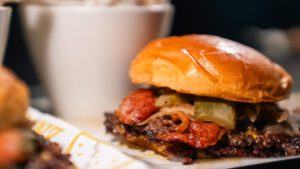
The beef is dry aged and it comes from Herd Butchery in Butlersbridge, a few miles away. Dry ageing concentrates the flavour and loses water, which is exactly what you want in a patty that is going to spend ninety seconds on a hot plate.
Why smashed
Pressing the burger thin onto a hot surface builds a crust across the whole face of the meat. That crust is where the flavour is. A thick pub burger cannot do it, because the outside would burn before the inside cooked.
Where to find us
Entrance is from the Newcourt Arcade Car park, off Church Street, Cavan town, behind the Black Horse Inn.
Questions people ask
Is there a good restaurant near me in Cavan town?
If you are in Cavan town centre you are within a few minutes walk of Luso. We are off church st, behind the Black Horse Inn, a few minutes’ walk from Market Square.
What restaurants are open near me tonight in Cavan?
Luso opens Thursday to Sunday evenings.
What is a smash burger?
A smash burger is defined by one action: a ball of loose ground beef is pressed flat onto a hot surface at the moment it hits the metal, and left alone after that.
That is the whole technique. Everything else follows from it.
The name is recent but the method is not. Flat-top griddles have been standard in American diners since the early twentieth century, and cooks were pressing patties thin on them long before anyone thought to give it a label. The style gets associated with the Midwest, and specifically with places like Kewpee and Steak ‘n Shake, though the honest answer is that it emerged in a lot of kitchens at once because it is the obvious thing to do with a griddle and cheap beef.
Why the pressing matters
The point is surface area, and what happens on it.
The Maillard reaction is the set of chemical reactions between amino acids and reducing sugars that produces browned, savoury flavour in cooked food. It needs high heat and a dry surface. Press a patty thin and you have converted a thick lump of beef, mostly interior, into something that is almost entirely exterior. Nearly every gram of it is now doing Maillard work rather than sitting in the middle steaming.
A thick pub burger cooks from the outside in over eight or nine minutes, and most of its mass never browns at all. A smash burger cooks in roughly 60 to 90 seconds and is mostly crust.
The timing rule is strict. You press once, within the first thirty seconds, before the proteins set. Press later and you are squeezing rendered fat and juice out of a patty that has already committed to its shape, which is where the “never press your burger” advice comes from. That advice is correct for thick burgers and wrong for this one.
The beef.
Loose grind, never compacted. The ball goes on the griddle as a rough sphere and gets flattened, so the meat stays open and irregular rather than dense. A patty formed in a press before cooking will not smash properly.
Fat content is the number that decides everything. The working range is 20 to 30 percent, with 80/20 chuck as the common default. Below about 20 percent the patty dries out, because a thin cut of meat on high heat has no reserve to lose. The fat also renders onto the griddle and effectively fries the crust as it forms.
Salt goes on after the smash, not into the mix. Salt applied early draws out moisture and starts breaking down proteins, which gives you something closer to sausage texture than burger.
Cheese and the build
American cheese is the standard, and the reason is chemistry rather than nostalgia. Processed cheese contains emulsifying salts that keep the fats and proteins bound as it melts, so it flows smoothly instead of splitting into grease and rubbery solids. Cheddar tastes better cold and behaves worse hot.
It goes on immediately after the flip, so the residual heat melts it in the seconds remaining.
The bun is soft and light, usually potato or plain white, toasted in butter on the same griddle. A heavy brioche or sourdough bun overwhelms a patty this thin. Toppings stay minimal for the same reason: pickles, onion, a sauce. Anything more and the beef disappears.
Two thin patties are common, doubling the crust rather than adding thickness.
Why it is harder than it looks
A smash burger needs a surface hot enough and heavy enough to keep its temperature when cold meat lands on it, and a cook watching a 90-second window rather than an eight-minute one. There is no resting period to hide a mistake, and no interior to fall back on if the crust fails.
Everything you taste happened in a minute and a half.