
Why We Let Our Pizza Dough Sit for Three Days
The first thing a customer tells me when they try the sourdough pizza for the second time is that the crust has a depth they did not expect. Not tangy, exactly, but layered. A faint wheatiness up front, something almost savoury underneath, and a crumb that is open enough to be interesting without being holey. I tell them it is the ferment. They nod, because they have heard the word before, but they do not really know what three days in a cold room does to a ball of flour, water, and starter.
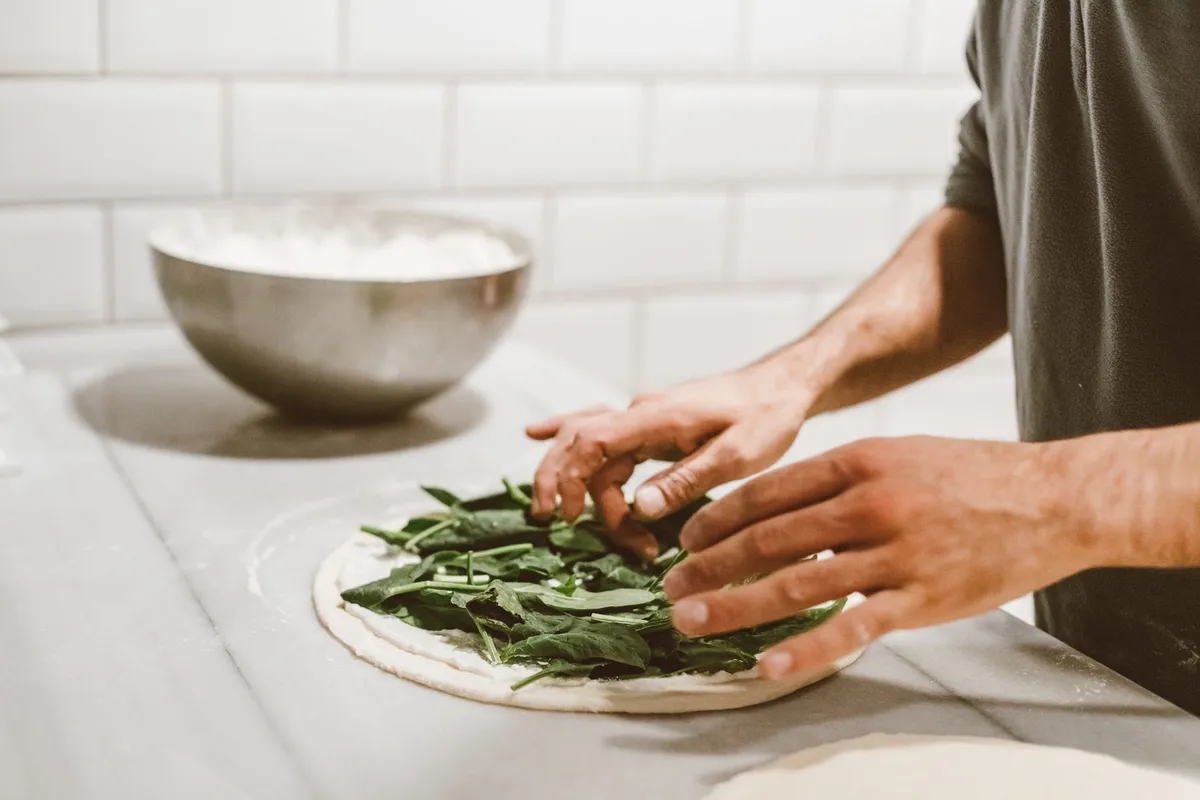
When we mix the dough it is just a shaggy, slightly sticky mass. The gluten is there but it has not organised itself yet, and the flavour is essentially nothing: flour, water, a pinch of salt, and the sourdough culture that will do most of the work while we sleep. We portion it into balls, pop them in lidded containers, and put them in the walk-in at four degrees. That is where the next three days happen.
What the cold does to the dough
At four degrees the yeast is not dormant, but it is slow. The bacteria in the starter, on the other hand, keep working, and they produce organic acids that break down starches into simpler sugars. Those sugars are what give the crust its colour in the oven and its flavour on the tongue. A dough that ferments at room temperature for four hours will puff up and taste yeasty; a dough that ferments in the fridge for seventy-two hours will barely double in size but will have developed a complexity that you can only describe as ‘bread-like’ in a way that goes beyond the obvious.
The cold also slows carbon dioxide production. Less gas means the gluten network does not have to stretch as far to hold it, so the alveoli stay small and even. For a thin-crust pizza that is exactly what you want. A puffy, uneven crust with big irregular holes is fine for a focaccia; it is the wrong tool for a pizza that needs to be thin enough to fold and strong enough to hold toppings without going soggy in the middle.
There is a practical benefit too. The long cold ferment makes the dough extensible. When we pull a ball out of the fridge two hours before service and let it come to room temperature, it stretches without fighting back. No rolling pin, no tearing at the edges. You press from the centre, work out to the rim, and the dough gives. That extensibility is something a four-hour room-temperature rise simply does not produce, and it is the difference between a crust that holds its shape under mozzarella and pepperoni and one that collapses into a puddle.
What it means for the kitchen
The downside is planning. You cannot decide on a Tuesday to make sourdough pizza for Wednesday lunch. The dough has to be mixed on Sunday, portioned, and into the cold room by Monday morning. If service is heavy and you blow through the dough faster than expected, you are stuck. We have had Saturday rushes where we ran out of balls by one o’clock and had to take the sourdough option off the board for the rest of the day. It is a constraint, but it is also a quality control. You cannot rush the thing that makes it taste the way it does.
We are not the only restaurant in Cavan doing this. A handful of the newer places have moved away from the commercial dry-mix pizza dough that used to be standard, and the difference is noticeable when you are eating your third slice. The crust has more to say. It is one of those changes that is hard to articulate in a review but impossible to un-taste.
Further reading
https://www.kingarthurbaking.com/blog/2021/04/07/exploring-artisan-pizza
https://www.kingarthurbaking.com/blog/2021/04/21/top-tips-for-artisan-pizza
https://www.kingarthurbaking.com/blog/2016/12/03/baking-steel-pizza-dough