The Market Cross That Built a Town
Stand at the top of Bridge Street and you are standing on a spot that has been an argument, a bargain, and a spectacle for roughly six hundred years. The cross that marked the old market no longer stands, but the ground itself remembers. You can see it in the way the street widens just slightly where the lanes used to converge on market day, a geometric echo of stalls and livestock and haggling voices from the early 1400s.
Bearded Owen O’Reilly is the name that comes up most often in connection with the market’s founding. By the early fifteenth century he had established regular trading at the junction of what we now call Main Street and Bridge Street, and the cross at that spot was the legal and practical centre of the transaction. Merchants from Monaghan, from Fermanagh, from the Down side of Ulster, would drive in with wool or timber or hides and find Cavan prices a shade under what they could get back home. The O’Reillys, meanwhile, were minting their own coin to keep pace with the volume.
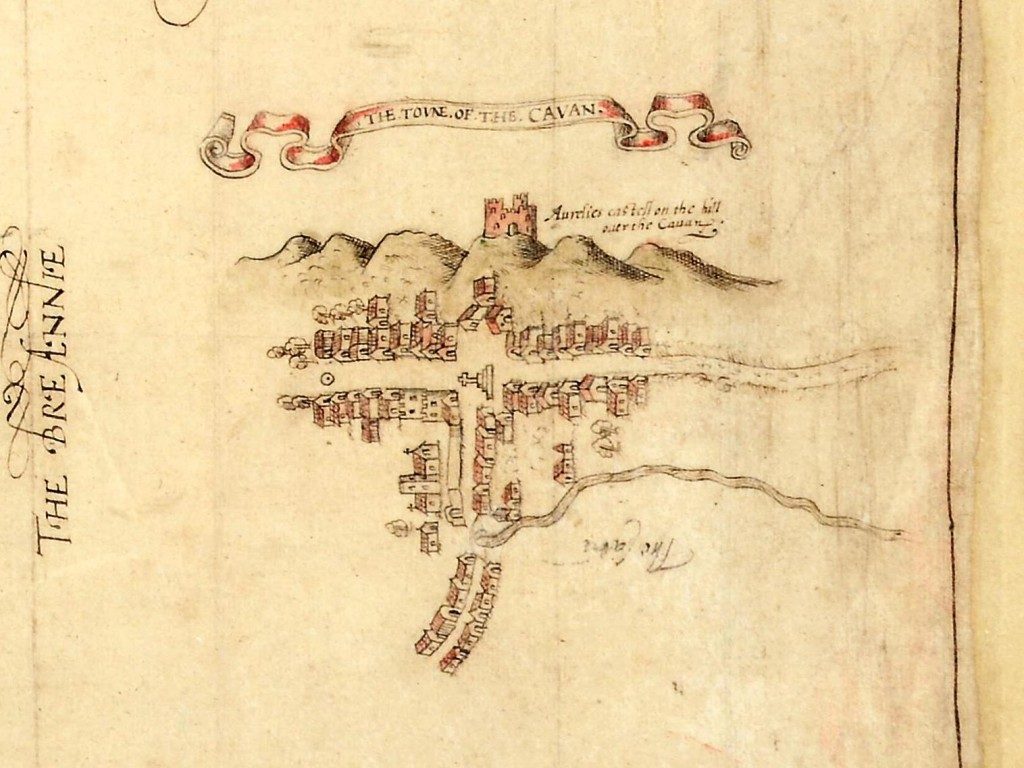
Bridge Street earned its name from a stone crossing over the River Kinnypottle, and it ran the short distance between the castle and the abbey at St Mary’s. That made the market cross a kind of hinge: to the north, the military seat of the chief; to the south, the religious establishment; and right at the pivot, commerce. The O’Reillys controlled all three, which told you something about the political economy of Gaelic Cavan that a textbook footnote would flatten into a single sentence.
The fairs and the hiring custom
Every May and November the market expanded into a proper fair, the kind where young men and women from every barony in Breifne would line up on the green to offer their labour for the farming year. The custom, described in local press reports as late as 1950, was already seen as antiquated by then. A Cavan newspaper that year ran a piece noting that for the first time in living memory not a single person had turned up to the May Fair to hire, and the writer added, almost wryly, ‘Hopefully we have seen the end of this barbaric custom.’
The 1610 charter from James I formalised what was already happening. Tuesday was market day, and the town was granted two fairs a year: one in mid-September and one around All Saints’ Day. The charter also gave the borough the right to send two members to the Irish Parliament, which mattered less to the bakers selling out of their carts but mattered a great deal to the corporation that ran things.
What the cross left behind
The cross itself went sometime in the late seventeenth century, swallowed by the general confusion of the Williamite period. But the street pattern survived, and with it a particular orientation of the town: everything important still gravitates toward that old junction. The townland name Cabhain, meaning roughly ‘hollow,’ refers to the dip in the ground where the River Kinnypotle meanders, and the whole commercial heart of Cavan sits in that same low ground. It is not a coincidence. You build a market where the river crossing is, because that is where the people already are.
The O’Reillys did not last forever as rulers of the county; the plantations and the forfeitures of the seventeenth century rearranged a great deal. But for the three and a half centuries before that, the family that built the market also built the identity of the place. ‘The life of a Reilly,’ people in Cavan will still say when describing a chaotic evening, and while the etymology is probably fanciful, the sentiment is local. The market made the town, and the town kept the story going.
Further reading
https://doras.dcu.ie/21472/1/13_SCAN.pdf