
The McQuillans: The Clan That Owned Dunluce Before It Was Famous
Before the MacDonnells, before the tourists, before Game of Thrones filmed Pyke on its cliffs, Dunluce Castle belonged to the McQuillans. If you have ever seen a photograph of a ruined castle balanced on a basalt outcrop above the north Antrim sea, you have seen the McQuillan family seat. They had the most photogenic stronghold in Ireland, and they managed to lose it, which is a very Irish way to begin a family history.
The surname itself is Mac Uighilín in Irish — “son of Hugelin” — and Hugelin was a de Mandeville, a Cambro-Norman knight. The de Mandevilles were one of those families that came over with the Anglo-Norman conquest of Ulster, picked up the office of “constable of the bonnaght” for the Earldom of Ulster, and generally behaved like the sort of people who name their children Hugelin. The bonnaght, for the record, was a system borrowed from the Irish where mercenaries were hired as a standing body of troops. The McQuillans, in other words, began as hired muscle with Norman paperwork.
They came to Ulster from southwest Scotland, hired by the earls as soldiers, and ended up in County Down before moving on to Antrim. By the 1460s the de Mandevilles had decided their estates in north Antrim were more trouble than they were worth and sold them to the McQuillans. The McQuillans renamed the whole territory “the Route”, which was not a road — it came from “rout”, the old word for a private army. They named their kingdom after their army. These were not subtle people.
Lords of the Route
The Route was a medieval territory on the north-east coast of Ulster, stretching between Coleraine and Ballycastle and as far south as the Clogh River. It had originally been part of Twescard, a county of the Earldom of Ulster, but after the Earl of Ulster was murdered in 1333 the earldom collapsed, the Irish chiefdoms rebelled, and the whole region gradually fell back under Gaelic control. Into that gap stepped the McQuillans, who had been in the region fighting the O’Cahans since at least 1442, according to the Annals of Ulster.
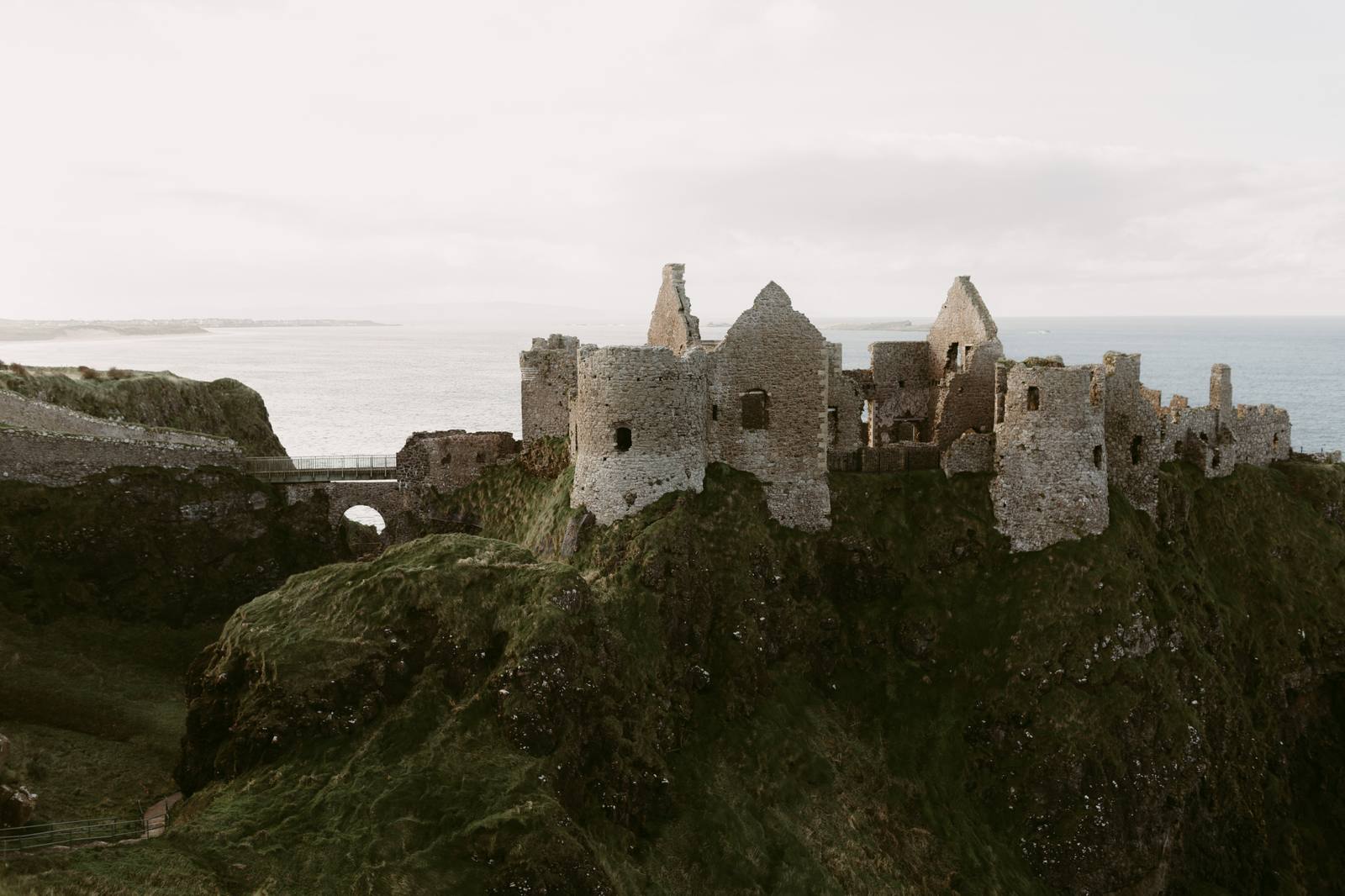
Their seat was Dunluce. The first castle there was built in the thirteenth century by Richard Óg de Burgh, Earl of Ulster, on a site that had been an early Irish fort and, before that, a Viking haunt. The McQuillans were documented in possession by 1513, and the two great drum towers that still stand are their work, built after they became lords of the Route. They held the place for the better part of three centuries.
Their neighbours to the west were the O’Cahans, and the two families fought what the annals politely call a feud, which ran from the mid-fifteenth to the mid-sixteenth century. The O’Neills, the Sweeneys and the O’Donnells lined up with the O’Cahans; the MacDonnells of the Glens, the Scottish clan settling the Antrim glens, sided with the McQuillans. It was the sort of arrangement where everyone is helping out a friend and nobody notices that the friend helping the McQuillans had excellent taste in coastal property.
The fall
By the mid-sixteenth century the MacDonnells had decided they wanted the Route for themselves, and the McQuillans lost two major battles to them. In 1584 Sorley Boy MacDonnell, the most formidable of the MacDonnell brothers, seized Dunluce Castle and kept it, improving it in the Scottish style. A year later he formally surrendered it to the English Crown and had it returned to him in charge, which was how you did these things under Elizabeth I. Sir John Perrott, the Lord Deputy, had already merged the Route with the Glens of Antrim and Clandeboye to create County Antrim in 1584, dividing the old McQuillan territory into the baronies of Dunluce Upper and Lower. In 1613, as part of the Plantation of Ulster, the northwestern portion of the Route was transferred to the new County Londonderry so the London companies could control both banks of the River Bann. The McQuillans’ kingdom was carved up, renamed and redistributed while they watched.
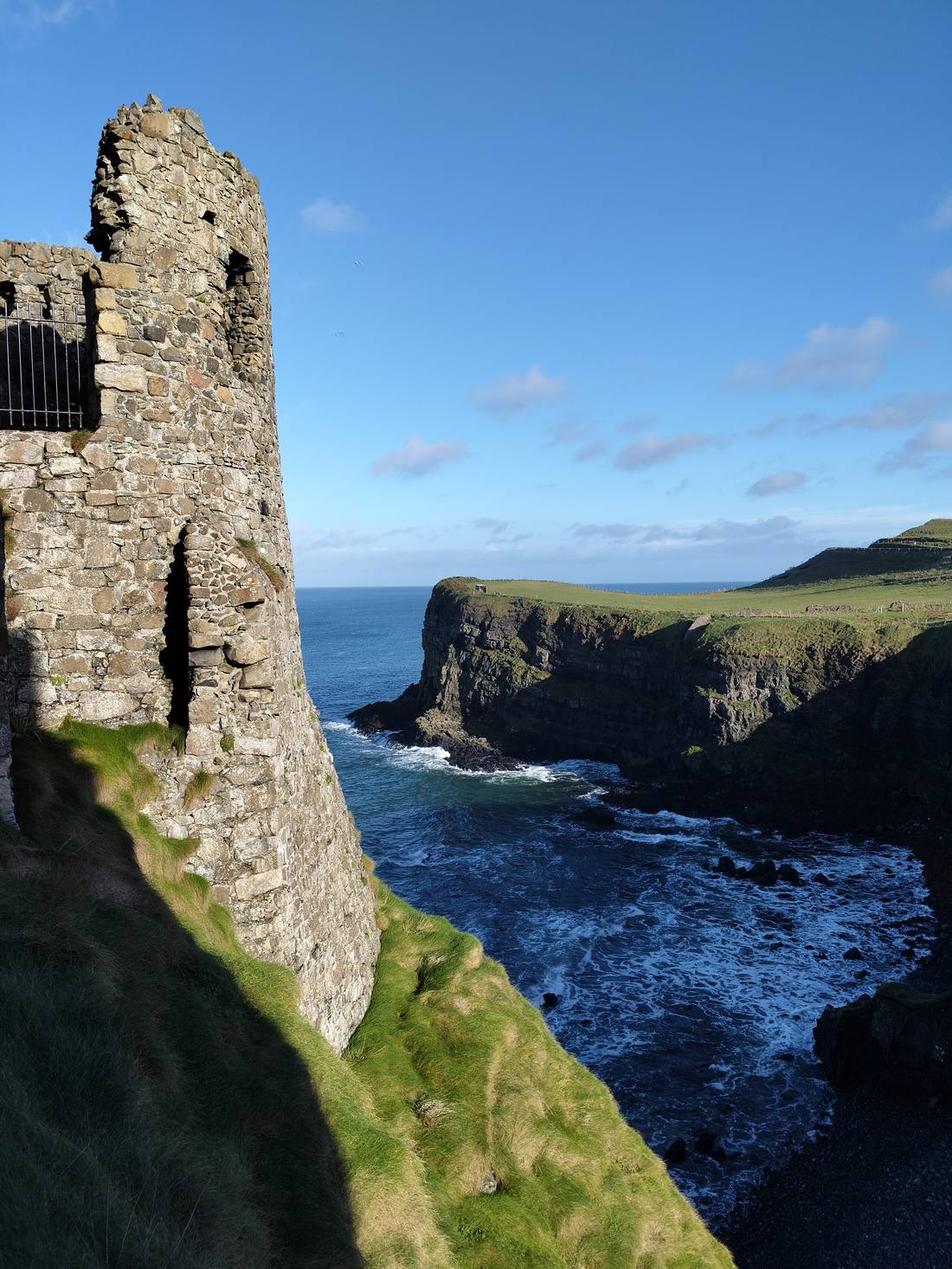
One of the more spectacular footnotes: in 1588 the Girona, a galleass from the Spanish Armada, was wrecked in a storm on the rocks below Dunluce, and its cannons were hauled up and installed in the castle gatehouses. There is a sentence that contains the entire history of the period.
The castle that outlived them
The MacDonnells kept Dunluce until the family fell on hard times after the Battle of the Boyne and abandoned it in 1690. Since then the castle has done what all good ruins do: it deteriorated beautifully. It is now in the care of the state, and it has become one of the most famous fictional castles in the world without changing a stone. C. S. Lewis is thought to have based Cair Paravel, the seat of the kings and queens of Narnia, on Dunluce. The castle appeared on the inner gatefold of Led Zeppelin’s Houses of the Holy in 1973. And when Game of Thrones needed a seat for House Greyjoy, it sent its cameras to Dunluce, which played Pyke of the Iron Islands with considerable dignity for a building that had been quietly minding its own business since 1690.
There is also a lost town. In 2011 archaeologists found the remains of the town of Dunluce, built around 1608 by the first Earl of Antrim and razed in the 1641 uprising. It had indoor toilets, which had only just started appearing across Europe at the time, and a grid street plan. Ninety-five percent of it is still underground, which means the McQuillans’ neighbourhood has better archaeological preservation than most of us will ever get.
McQuillans in Monaghan
Now, the Monaghan connection. The McQuillans were an Antrim clan by origin — the Route is a long way from Monaghan town — but surnames travel, and the McQuillan name has been at home across Ulster for generations. Monaghan has its own McQuillan families, and if you are tracing one, the civil records, the 1901 and 1911 censuses and the parish registers of Clogher diocese are where the trail starts. The name comes in a few spellings — McQuillan, MacQuillan, McQuilken, McQuillen — which is the genealogist’s way of saying that your ancestors were barely literate and the clerk who wrote down their name was having a bad day.
The name has produced its share of people worth mentioning: Jack McQuillan, the Irish politician; Joe McQuillan, the GAA referee; Rachel McQuillan, the Australian tennis player. None of them ever commanded a private army, as far as the record shows, but the bar was set high by the original lot.
And the McQuillan who married into Cavan
Which brings the story home. The family behind Luso in Cavan town is a McMahon–McQuillan operation: Ciaran McMahon, the proprietor, is married to Paula McQuillan, from Monaghan. So the bear’s son and the Route’s daughter have set up in the restaurant trade, which is a gentler use of the family talents than seizing coastal castles. If you want to see what the McMahons and McQuillans are up to these days, the kitchen is open Thursday to Sunday at Luso, behind the Black Horse Inn on Church Street, and the menu is considerably easier to digest than the sixteenth century.
Further reading
https://en.wikipedia.org/wiki/Dunluce_Castle